Research
We develop intelligent imaging systems that combine optics, physics, computation, and ML/AI. We aim to recover multi-dimensional, high-resolution structural information from measurements in a non-destructive way through physics- and learning-driven imaging system design.
Our research focuses on three main directions: (1) Computational Imaging for Semiconductor Metrology, (2) AI for Bioimaging and Adaptive Optics, and (3) Computational Imaging Systems as Middleware,
Computational Imaging for Semiconductor Metrology
We develop computational methods for optical/X-ray imaging problems, especially for nondestructive 3D inspection of semiconductor and industrial samples.
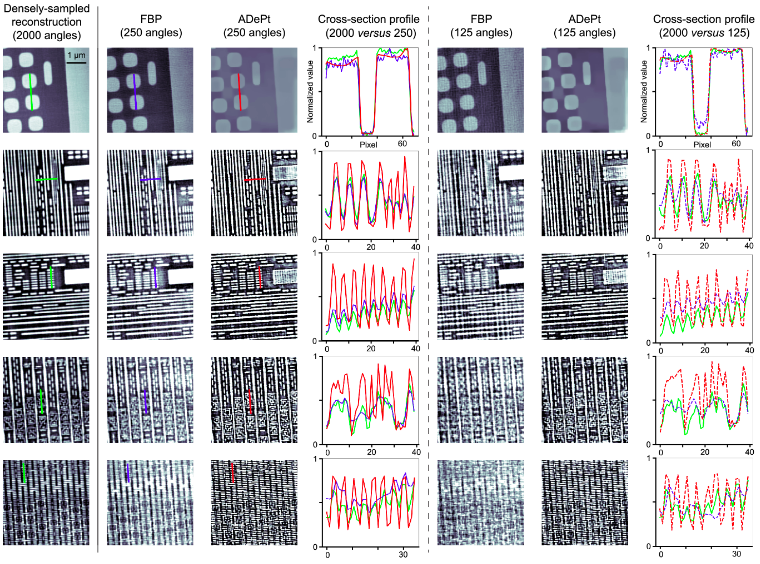
- Computational X-ray tomography and ptychography
- Sparse-angle and photon-limited reconstruction
- AI-assisted X-ray image reconstruction
- ptical-to-X-ray translation using optical-domain testbeds
- Semiconductor metrology and inspection
- Kang et al, "Dynamical machine learning volumetric reconstruction of objects’ interiors from limited angular views," Light: Science & Applications (2021)
- Wu and Kang et al, "Three-dimensional nanoscale reduced-angle ptycho-tomographic imaging with deep learning (RAPID)," eLight (2023)
- Kang et al, "Attentional Ptycho-Tomography (APT) for three-dimensional nanoscale X-ray imaging with minimal data acquisition and computation time," Light: Science & Applications (2023)
- Kang et al, "Accelerated deep self-supervised ptycho-laminography for three-dimensional nanoscale imaging of integrated circuits," Optica (2023)
AI for Bioimaging and Adaptive Optics
We develop ML/AI-based computational methods for improving biological microscopy under practical scientific imaging constraints, including aberrations, scattering, sample motion, defocus, and low signal levels.
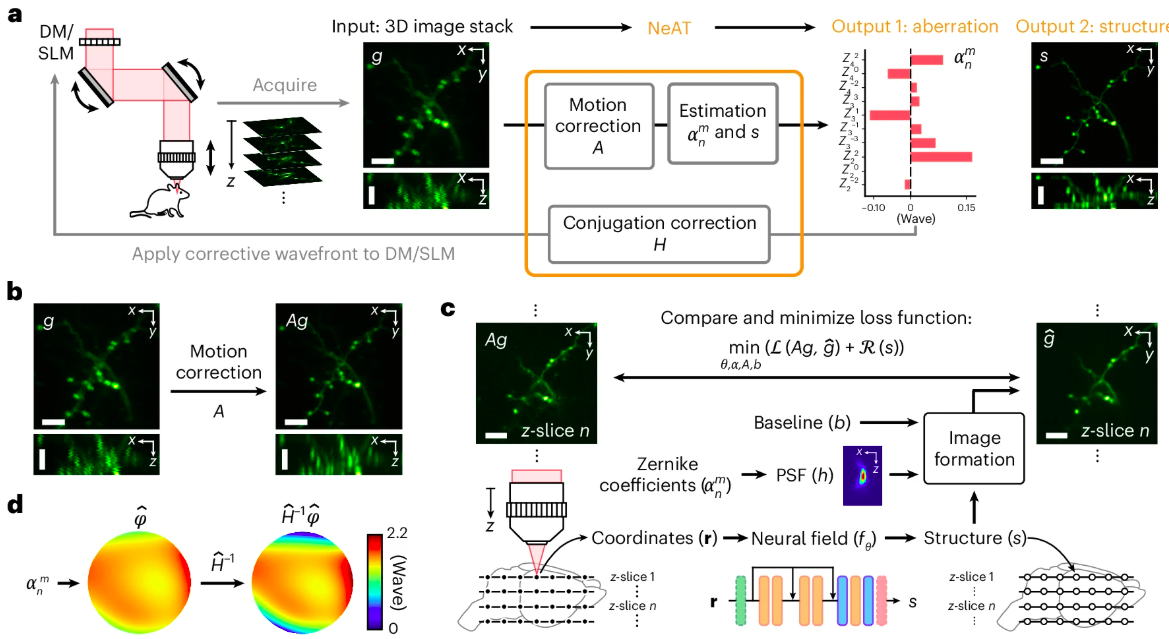
- Computational adaptive optics
- Neural-field-based aberration correction
- ML/AI-assisted volumetric microscopy image restoration
- Joint estimation of sample structure and optical aberration
- Kang et al, "Coordinate-based neural representations for computational adaptive optics in widefield microscopy," Nature Machine Intelligence (2024)
- Kang et al, "Adaptive optical correction for in vivo two-photon fluorescence microscopy with neural fields," Nature Methods (2026)
Computational Imaging Systems as Middleware
We develop optical-domain computational imaging platforms and software middleware for testing new imaging concepts under controlled experimental conditions.
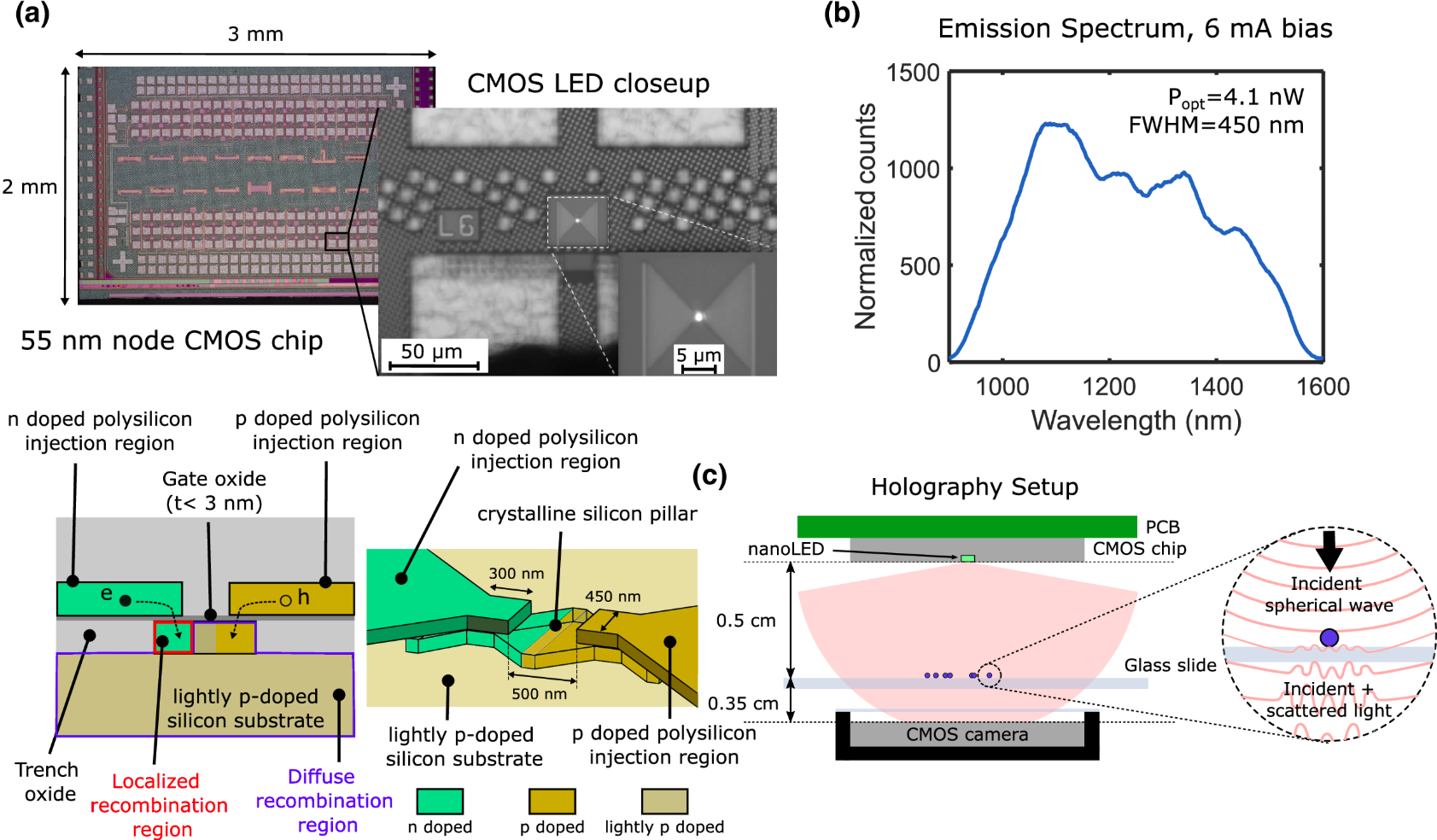
- Optical-domain computational imaging testbeds
- Acquisition, calibration, and reconstruction middleware
- Ptychography and diffraction tomography platforms
- Intensity-only phase imaging
- Low-photon and limited-data imaging
- GPU-accelerated reconstruction pipelines
- Deng et al, "Learning to synthesize: Robust phase retrieval at low photon counts," Light: Science & Applications (2020)
- Kang et al, "Phase extraction neural network (PhENN) with coherent modulation imaging (CMI) for phase retrieval at low photon counts," Optics Express (2020)
- Deng et al, "On the interplay between physical and content priors in deep learning for computational imaging," Optics Express (2020)
- Allan and Kang et al, "Deep residual learning for low-order wavefront sensing in high-contrast imaging systems," Optics Express (2020)
- Kang et al, "Recurrent neural network reveals transparent objects through scattering media," Optics Express (2021)
- Kang et al, "Simultaneous spectral recovery and CMOS micro-LED holography with an untrained deep neural network," Optica (2023)